



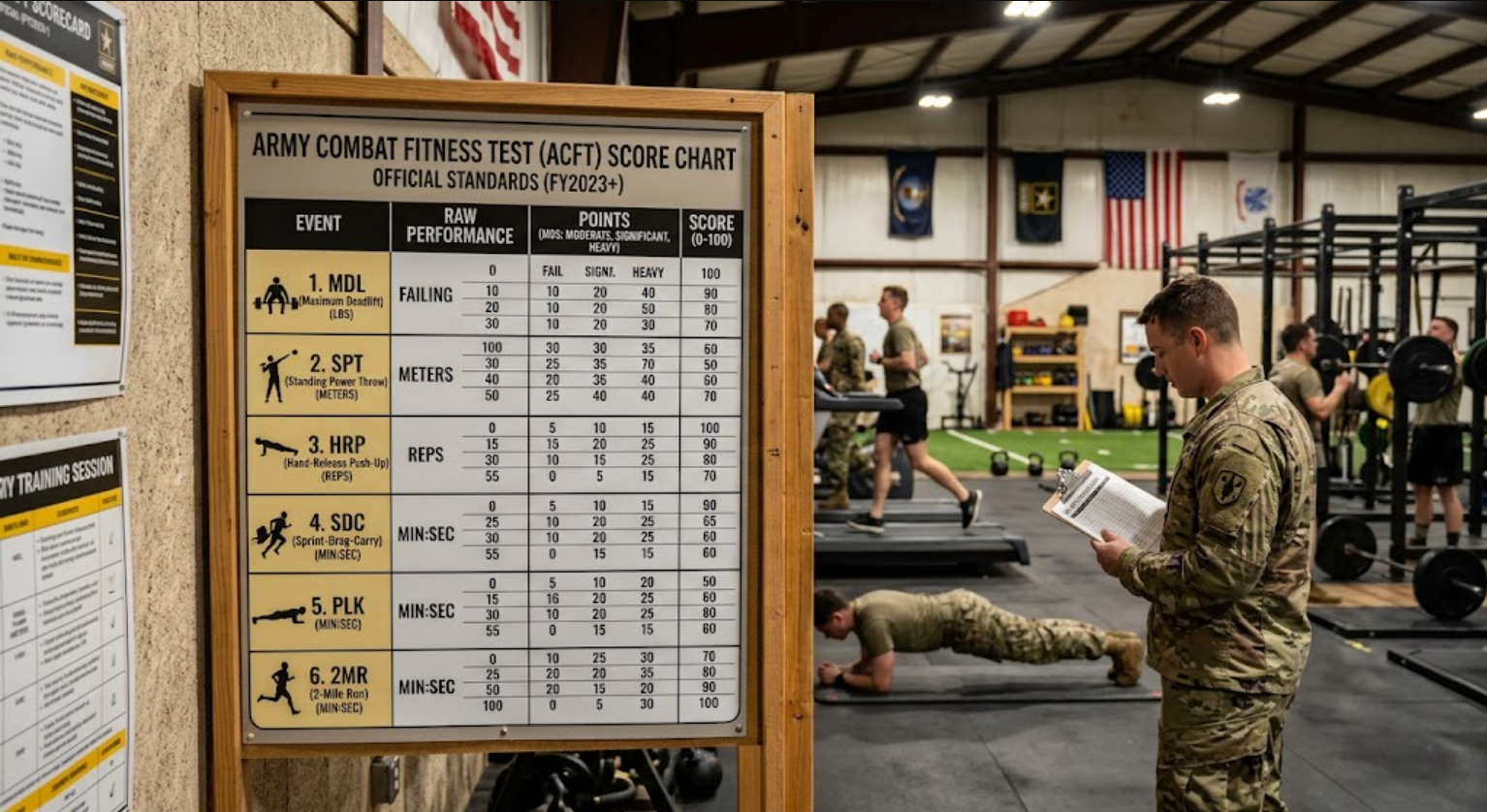
The army acft score chart helps Soldiers understand how their performance in each Army Combat Fitness Test event translates into points. The ACFT originally measured six areas of physical fitness through the 3-Repetition Maximum Deadlift, Standing Power Throw, Hand-Release Push-Up, Sprint-Drag-Carry, Plank, and 2-Mile Run. Each event had its own scoring requirements, allowing Soldiers to see how individual strengths and weaknesses affected their overall fitness score. Using the chart during training can also make preparation more focused because it shows the performance levels needed to improve an event score rather than simply counting repetitions, weight, distance, or time.
How the Army ACFT Scoring System Works
The army acft score chart was designed to convert performance in each ACFT event into a point value. Soldiers could earn up to 100 points per event, creating a possible maximum score of 600 points across six events. The system required Soldiers to meet the minimum standard for each event rather than relying only on a high overall score. This approach encouraged balanced fitness because strong performance in one event could not simply compensate for failing another. The scoring system therefore gave Soldiers a clear way to identify areas that needed more training before an official assessment.
The scoring process also made progress easier to track. A Soldier could record results from practice sessions and compare them with the appropriate scoring table to estimate an overall performance level. For example, improving the deadlift or reducing the 2-mile run time could increase the corresponding event score. However, Soldiers should always check the latest Army guidance when using an older ACFT chart because the Army replaced the ACFT with the Army Fitness Test (AFT) beginning in 2025.
ACFT Events and Their Individual Scores
The original ACFT included six events that tested different aspects of physical readiness. The 3-Repetition Maximum Deadlift measured lower-body and overall strength, while the Standing Power Throw tested explosive power. The Hand-Release Push-Up assessed upper-body muscular endurance, and the Sprint-Drag-Carry combined speed, strength, agility, and conditioning. The Plank measured core endurance, while the 2-Mile Run evaluated aerobic endurance. Looking at each event separately helps explain why the Army used a broad scoring system rather than depending on a single fitness measurement.
Each event contributed points toward the total ACFT score, with performance standards varying according to the applicable scoring tables. This meant that two Soldiers with the same overall score could have very different event profiles. One might achieve excellent strength and power results but perform less strongly in running, while another might show the opposite pattern. For training purposes, this makes the score chart useful for identifying specific weaknesses and setting measurable goals.
How Age and Gender Affect ACFT Scores
One of the most important features of the revised ACFT scoring system was its use of age- and gender-normed standards. The Army developed scoring tables to account for differences in physical performance across age groups and between male and female Soldiers. Instead of applying exactly the same performance number to every Soldier, the scoring framework considered demographic factors when assigning points. This approach aimed to create standards that reflected differences in physical performance while maintaining defined Army fitness requirements.
When using an ACFT score chart, Soldiers therefore needed to make sure they were consulting the correct age group and applicable category. Using a table intended for another group could produce an incorrect estimate of the score. This is particularly important when researching older ACFT information online because different versions of the test and scoring system appeared during the ACFT’s development and implementation. Official Army documentation remains the safest reference when historical scoring details need to be verified.
Minimum Passing Scores and Performance Standards
The revised ACFT introduced a straightforward minimum scoring principle: Soldiers generally needed to achieve at least 60 points in each event to meet the minimum performance requirement under the applicable standard. Since the test contained six events, the traditional minimum across all six events corresponded to 360 points if a Soldier earned exactly 60 points in every event. However, passing requirements and administrative rules could depend on the Soldier’s status, applicable policy, and the version of the Army fitness test being administered.
This distinction matters because a score that looks strong on an older chart may not represent the current requirement in 2026. The Army has transitioned from the six-event ACFT to the five-event AFT, so readers should not assume that an old 60-point-per-event ACFT reference automatically represents today’s standard. Anyone preparing for an official Army fitness assessment should use the current guidance provided through Army channels rather than relying solely on a historical chart.
How to Read and Use an Army ACFT Score Chart
Reading an army acft score chart becomes much easier when the events are considered one at a time. First, identify the Soldier’s applicable category and age group. Next, find the relevant event, such as the deadlift, hand-release push-up, Sprint-Drag-Carry, plank, or 2-mile run. The chart then connects a performance measurement—such as weight lifted, repetitions completed, time recorded, or distance achieved—with a corresponding point value. Adding the six event scores provides the overall ACFT result.
The chart can also support smarter training decisions. A Soldier who already scores highly in the deadlift but receives relatively few points for the 2-mile run may benefit more from improving cardiovascular endurance than from adding more strength work. Similarly, a Soldier with a weak Sprint-Drag-Carry score can focus on speed, agility, loaded movement, and conditioning. Used this way, the chart becomes a practical training reference rather than simply a document used on test day.
ACFT vs. the Current Army Fitness Test
The ACFT and the Army Fitness Test (AFT) should not be treated as identical tests. The Army announced the AFT as the replacement for the ACFT in 2025. The new test reduced the number of events from six to five and removed the Standing Power Throw. The AFT includes the 3-Repetition Maximum Deadlift, Hand-Release Push-Up Arm Extension, Sprint-Drag-Carry, Plank, and 2-Mile Run. This change means that many ACFT score charts found online now serve primarily as historical references.
The transition also introduced updated standards based on occupational requirements. The Army established a combat standard for Soldiers in designated combat specialties and a general standard for other Soldiers. Because the applicable requirements can differ, someone searching for an army acft score chart in 2026 should first determine whether they actually need historical ACFT information or the current AFT standards. That simple distinction can prevent confusion when comparing scores from different Army fitness-test systems.
Common Mistakes When Using ACFT Score Charts
One common mistake is using an outdated chart without checking which version of the ACFT it represents. The test went through several stages of development, and scoring policies changed before and after implementation. Another mistake involves looking only at the overall score while ignoring individual event requirements. A high total does not necessarily mean a Soldier met every applicable event standard. Readers should also avoid mixing scoring tables from different versions because the resulting calculation may not accurately represent an official score.
Another problem is confusing historical ACFT information with current AFT requirements. Since the Army has moved to the AFT, an online page that simply labels an old six-event table as the “2026 Army score chart” can be misleading. For accurate preparation, Soldiers should verify the current standard through official Army resources and use older ACFT charts only when researching previous requirements, comparing historical results, or understanding how the Army’s fitness testing system evolved.
Conclusion
The army acft score chart remains useful for understanding how the former six-event Army Combat Fitness Test converted physical performance into points. It can help explain historical requirements, evaluate past scores, and show how different fitness abilities contributed to an overall result. However, the Army’s transition to the Army Fitness Test means older ACFT charts should not automatically be considered the current 2026 standard. For anyone preparing for an official test, checking the latest Army guidance is essential to ensure the correct events, scoring system, and performance requirements are being used.
FAQs
What is the maximum ACFT score?
The traditional ACFT had six events worth up to 100 points each, giving a maximum possible score of 600 points.
What was the minimum ACFT event score?
Under the revised ACFT scoring system, the general minimum was 60 points per event, subject to the applicable Army requirements.
Is the ACFT still used in 2026?
No. The Army transitioned from the ACFT to the Army Fitness Test (AFT), which became the Army’s new fitness-test framework.
Where can I find official Army fitness standards?
The safest source is the official U.S. Army, rather than an unofficial score-chart website or an outdated social-media post.
